A science-backed tool for early literacy
I remember first reading about sound walls several years ago. It was such a new concept, and word walls were so ingrained in our daily practice, that I had to get special permission from administration to try one in my classroom. What I discovered was a powerful resource and teaching tool that helped my students make connections between teaching and print. It’s time to rethink the traditional Word Wall and consider a Sound Wall, which is a research-based tool that aligns with how children naturally learn language.
What is a Sound Wall?
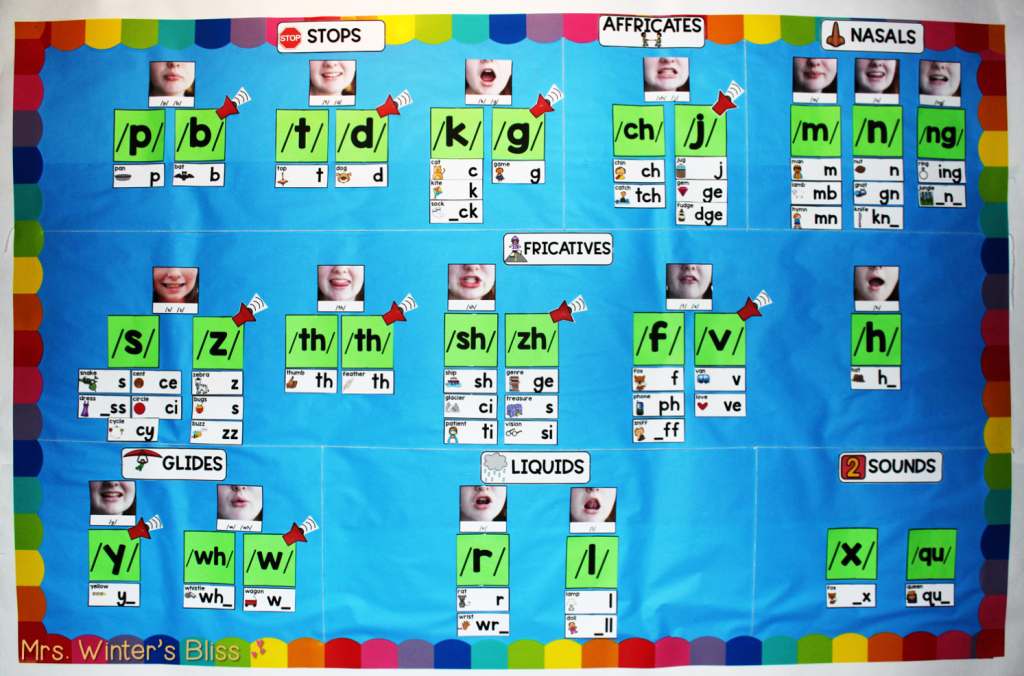
A Sound Wall is a visual display that organizes words by phonemes (the smallest units of sound) rather than by the first letter. This approach supports speech-to-print instruction, helping students connect the sounds they hear to the letters and letter combinations (graphemes) that represent them.
This example (below) is from Mts. Winter’s Bliss.
Why Use a Sound Wall?
- It supports phonemic awareness, a critical skill for decoding and spelling.
- It aligns with the Science of Reading, which emphasizes explicit, systematic instruction in phonics and phonology.
- It helps students understand that one sound can be spelled in multiple ways (e.g., /k/ = c, k, ck, ch).
- It shows students that sounds can be voiced or unvoiced, but the place of articulation can be the same. (e.g., /f/ and /v/)
Key Components:
- Vowel Valley: This is a visual map of vowel sounds based on mouth position. The sounds cards are placed in a V pattern and move from vowels formed with a partially closed mouth, to vowels formed with an open mouth, to vowels formed with a “smile.”
- Consonant Chart: This is separate from vowel sounds and organized by how and where sounds are produced in the mouth.
- Articulation Cues: Mouth pictures, mirrors, and cues about how the sound is voiced help students see how sounds are formed.
Sound Walls are a powerful instructional tool that help students become confident, capable readers…but they only work if they are used often and with student interaction. Have you tried a Sound Wall in your classroom?
 Guidemap to Reading
Leave a comment